

Multiple sclerosis affects millions of individuals across North America. For many patients, conventional medicine delivers unpredictable results. Patients often rely on daily immunosuppressants, disease-modifying therapies, or steroid infusions. However, these options rarely repair damaged nerve fibers. Furthermore, long-term pharmaceutical regimens frequently trigger severe systemic side effects.
Consequently, patients are seeking non-invasive cellular interventions. Stem cell therapy for multiple sclerosis has emerged as a groundbreaking medical protocol. At Kyron Medical, our specialized protocols focus on calming persistent neuroinflammation. Moreover, our clinical team targets damaged neural pathways using high-potency umbilical cord Mesenchymal Stem Cells (UC-MSCs).
Stem Cell Therapy for Multiple Sclerosis Overview
Understanding Multiple Sclerosis and Neuroinflammation
Multiple sclerosis is a chronic autoimmune condition. In healthy bodies, the immune system defends against foreign pathogens. However, in MS patients, hyperactive T-lymphocytes cross the blood-brain barrier mistakenly. Subsequently, these aggressive cells attack the protective myelin sheath surrounding central nervous system axons.
This recurring autoimmune assault disrupts electrical signals between the brain and body. As a result, patients experience debilitating clinical symptoms:
Progressive Motor Impairment: Muscle weakness, foot drop, and severe loss of physical coordination.
Chronic Sensory Disruption: Persistent numbness, tingling sensations, and sharp neuropathic pain.
Severe Fatigue: Overwhelming daily exhaustion that physical rest does not alleviate.
Cognitive and Vision Changes: Optic neuritis, double vision, and reduced information processing speeds.
Traditional pharmaceuticals primarily suppress the broader immune system. In contrast, regenerative cellular protocols seek to re-educate the immune response. By halting the microglial inflammatory cycle, stem cell therapy protects surviving axons from irreversible degeneration.
The 4 Pillars of the Kyron Neurological Protocol
Pre-Therapy Metabolic Preparation
We administer targeted antioxidant and nutrient infusions. This optimizes your tissue microenvironment for improved cellular survival.
High-Potency IV Administration
Over 100 million expanded umbilical cord stem cells enter systemic circulation through a comfortable, continuous medical drip.
Neurovascular Supportive Care
We combine hyperbaric oxygen protocols and vital co-factors to promote optimal oxygen delivery and stimulate neurotrophic signaling.
Longitudinal Telehealth Monitoring
Dr. Carlos Rojas reviews your mobility milestones and functional outcomes at 30, 90, 180, and 365 days after returning home.
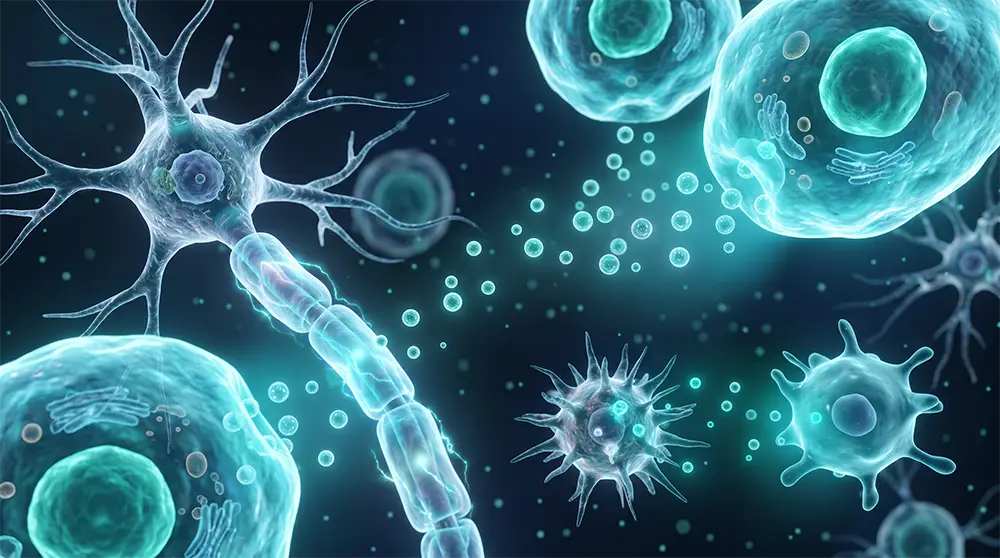
Mechanisms of Action: How Umbilical Cord MSCs Protect Neural Pathways
Mesenchymal stem cells derived from umbilical cord Wharton’s Jelly exhibit extraordinary biological traits. Unlike aged bone marrow cells, these youthful cells maintain pristine cellular vigor. Furthermore, they carry zero exposure to environmental toxicity or biological senescence.
Once administered systemically via controlled intravenous infusion, these cells deploy three primary biological mechanisms:
1. Robust Immunomodulation
Umbilical cord MSCs modulate overactive immune pathways directly. Specifically, they inhibit inflammatory Th1 and Th17 cell proliferation. Simultaneously, they stimulate the production of protective regulatory T-cells (Tregs). Consequently, this rebalancing stops the immune system from attacking myelin sheaths.
2. Powerful Paracrine Signaling and Secretome Release
Mesenchymal stem cells act as intelligent biological signal directors. Rather than replacing entire neural networks instantly, they release powerful exosomes, microRNAs, and neurotrophic factors. In particular, they secrete Brain-Derived Neurotrophic Factor (BDNF) and Glial Cell Line-Derived Neurotrophic Factor (GDNF). These biochemical signals stimulate resident oligodendrocytes to initiate intrinsic tissue preservation.
3. Disruption of Chronic Neuroinflammation
Microglial cells in the central nervous system often remain stuck in a destructive “M1” pro-inflammatory state. UC-MSCs release anti-inflammatory cytokines, including IL-10 and TGF-beta. These proteins shift harmful microglia into a beneficial “M2” healing phenotype, calming chronic neurovascular swelling.
Immune Re-Education
UC-MSCs restore balance between pro-inflammatory Th17 cells and protective regulatory T-cells to halt autoimmune attacks.
Neuro-Protection
Signaling peptides protect vulnerable oligodendrocytes, promoting an optimal environment for endogenous myelin preservation.
Inflammation Reduction
Powerful anti-inflammatory cytokines suppress chronic central nervous system microglial hyperactivity.
Why Cell Dosage and Cellular Youth Dictate Neurological Success
The human central nervous system presents complex biological barriers. Therefore, low cellular dosages rarely deliver significant neurological impact. In standard autologous procedures, physicians harvest cells from the patient’s own aging tissue. Unfortunately, a patient diagnosed with MS has stem cells that reflect the same biological fatigue as their body.
In contrast, Kyron Medical utilizes expanded, day-zero umbilical cord stem cells. These cells replicate rapidly, possess elongated telomeres, and produce elevated quantities of regenerative cytokines. Moreover, laboratory expansion enables our clinical team to administer verified therapeutic dosages exceeding 100 million to 200 million active cells.
| Biological Characteristic | Aging Autologous Cells | Kyron Expanded Umbilical Cord MSCs |
| Cell Origin | Patient’s own hip bone or fat | Donated, healthy full-term umbilical cords |
| Extraction Discomfort | Painful surgical bone aspiration | Zero extraction trauma (Laboratory prepared) |
| Cellular Biological Age | Equivalent to patient’s calendar age | Day Zero (Maximum biological vigor) |
| Average Viable Dose | 2 to 5 Million uncultured cells | 100 to 200+ Million verified active cells |
| Replication Speed | Slow and prone to cellular senescence | Rapid, exponential doubling times |
| Immunomodulatory Power | Diminished due to chronic systemic illness | Exceptionally potent cytokine expression |
High-Dose Systemic Infusion
100M+ Expanded Umbilical Cord MSCs circulate throughout the bloodstream to modulate systemic immunity and cross vascular micro-barriers.
Targeted Neuro-Metabolic Support
Co-administration of clinical exosomes and vital co-factors amplifies biological signaling, accelerating endogenous myelin repair mechanisms.

The Kyron Medical Patient Journey: Restoring Functional Independence
Receiving treatment for multiple sclerosis requires absolute medical precision, transparency, and clinical excellence. Under the medical direction of Dr. Carlos Rojas, Kyron Medical delivers a comprehensive international patient experience tailored specifically for individuals seeking neurological rehabilitation.
First, our medical board conducts a comprehensive pre-travel review of your brain and cervical spine MRIs. This initial telehealth evaluation ensures you are an ideal candidate for therapy. Second, upon your arrival in Cali, Colombia, our private bilingual concierge manages all executive transportation and clinic logistics.
During your treatment week, you receive continuous medical supervision. We combine systemic intravenous MSC infusions with supportive therapies designed to maximize cellular vitality. Finally, our medical team conducts structured follow-up consultations at 30 days, 90 days, 6 months, and 12 months after your return home. We monitor your neurological milestones, coordinate with your local therapists, and support your ongoing progress.
Explore Stem Cell Protocols for Multiple Sclerosis
Schedule a complimentary MRI and medical history review with Dr. Carlos Rojas. Learn how our advanced cellular protocols can support your mobility and quality of life.
Connect With Our Medical TeamFrequently Asked Questions
Clear answers regarding stem cell therapy for multiple sclerosis and your medical journey.
How does stem cell therapy help patients with multiple sclerosis?
Stem cell therapy introduces high-potency mesenchymal stem cells (MSCs) that regulate overactive immune responses. Furthermore, these cells secrete powerful anti-inflammatory cytokines. This action reduces neuroinflammation and helps protect the myelin sheath from ongoing degradation.
What is the primary difference between umbilical cord MSCs and bone marrow?
Umbilical cord-derived stem cells are harvested from Day-Zero tissue. Therefore, they maintain pristine cellular youth, rapid doubling times, and maximum vitality. In contrast, bone marrow cells match the chronological age of the patient and exhibit diminished regenerative capacity.
Is there any risk of cellular rejection or graft-versus-host disease?
No. Mesenchymal stem cells from Wharton's Jelly are immunologically privileged. They do not express mature HLA-DR antigens. Consequently, your immune system does not recognize them as foreign invaders, eliminating the risk of tissue rejection.
How are the stem cells administered for multiple sclerosis?
Our clinical team administers cells through a high-dose intravenous (IV) infusion. The procedure is painless, non-surgical, and takes place in a private executive suite under continuous medical monitoring.
How many stem cells do patients typically receive?
Depending on your body weight and disease severity, Dr. Carlos Rojas prescribes therapeutic doses ranging from 100 million to over 200 million verified viable MSCs.
How long do international patients need to stay in Colombia?
Most international patients complete their personalized treatment protocol within 3 to 5 business days. This schedule allows ample time for clinical preparation, cellular infusions, and restorative relaxation.
When can patients expect to notice improvements?
Many patients report reduced systemic fatigue and improved energy within the first 4 to 8 weeks. Furthermore, progressive neurological improvements and motor stability typically develop over 3 to 6 months as tissue microenvironments stabilize.
Does stem cell therapy cure multiple sclerosis?
Stem cell therapy is not a definitive cure. Instead, it serves as an advanced supportive cellular therapy aimed at modulating immune activity, managing progressive symptoms, and protecting surviving neural structures.
Can I continue taking my prescribed medications?
Yes. During your initial virtual consultation, Dr. Carlos Rojas reviews your medication list. You should never stop your prescribed medications without direct medical supervision from your attending physician.
How does Kyron Medical coordinate post-care follow-up?
Our team schedules formal telehealth consultations at 30, 90, 180, and 365 days after your return home. We evaluate your functional progress, track your symptoms, and maintain open communication with you.